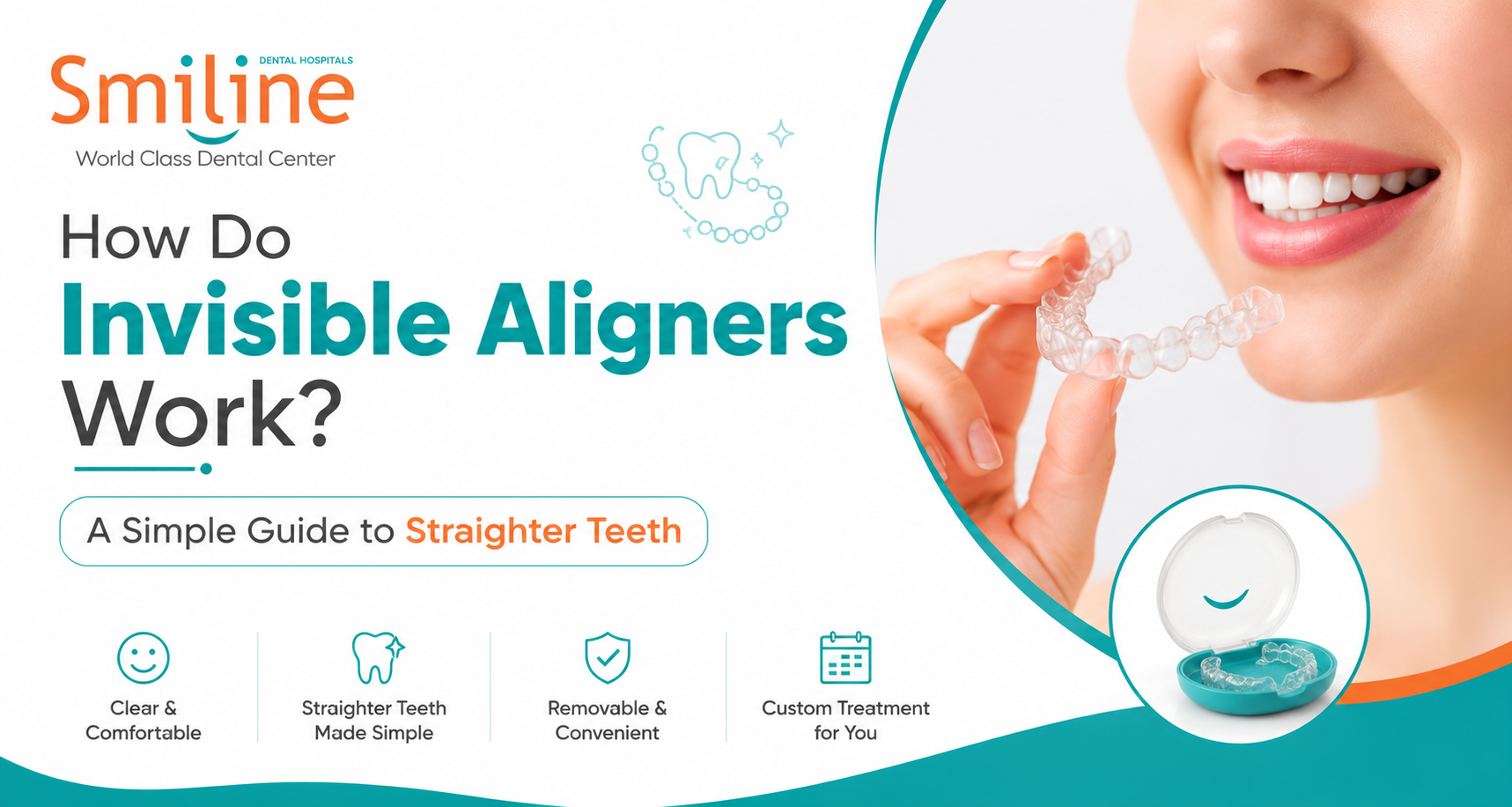
Clear aligners have made straightening teeth far more discreet than traditional braces. But many people searching online are not only worried about crooked teeth. They want to know whether aligners can correct the way their teeth meet, such as an overbite, underbite or crossbite.
The honest answer is that it depends. Aligners can treat many bite problems successfully, especially mild to moderate ones. More complex cases may need extra tools, a combination of treatments or a different approach altogether. Understanding how dentists make this decision can help you go into a consultation with realistic expectations.
What Counts as a Bite Problem?
A bite problem, known medically as malocclusion, means the upper and lower teeth do not meet in their ideal position. The most common types include:
- Overbite: The upper front teeth overlap the lower front teeth too much, either vertically (deep bite) or by sticking forward (overjet)
- Underbite: The lower front teeth sit in front of the upper front teeth
- Crossbite: Some upper teeth sit inside the lower teeth when you bite, at the front, the sides or both
- Open bite: The front teeth do not meet at all when the back teeth are closed
These problems can affect chewing, speech, tooth wear and jaw comfort, not just appearance.
The Key Question: Teeth or Jaws?
The most important factor in the decision is whether the problem comes mainly from the position of the teeth or from the size and position of the jaws.
Dental bite problems are caused by teeth that are tilted, rotated or positioned incorrectly. These often respond well to aligners, because aligners are designed to move teeth.
Skeletal bite problems are caused by a mismatch in jaw size or growth. Aligners cannot change bone structure in adults. Mild skeletal problems may sometimes be camouflaged by moving teeth, but more severe cases may need jaw surgery alongside orthodontic treatment.
To tell the difference, dentists usually take photographs, digital scans and X-rays, such as a panoramic X-ray or a side view of the skull called a cephalometric X-ray.
Can Invisalign® Fix Underbite?
The answer to “Can Invisalign® fix underbite?” depends largely on its cause. A mild underbite caused by tooth position can often be improved with aligners and elastics. When the lower jaw is significantly larger or further forward than the upper jaw, aligners alone are unlikely to correct it fully, and a combination of orthodontics and jaw surgery may be recommended.
Can Invisalign® Fix Crossbite?
People often ask, “Does Invisalign® fix crossbite?” or “Can you fix a crossbite with Invisalign®?” For a single tooth or a few teeth in crossbite, aligners can often move them into the correct position.
When the whole upper jaw is too narrow, the situation is different. In children whose jaws are still growing, the jaw can be widened with either a traditional expander or the Invisalign Palatal Expander, a removable device designed to correct skeletal crossbites. In adults, aligners can widen the arch slightly by tipping the teeth outward, but larger skeletal problems may need surgically assisted expansion.
With the right appliance and careful assessment, many dental and skeletal crossbites can be corrected, especially when treatment begins while the jaw is still growing.
Other Factors Dentists Consider
Beyond the type of bite problem, several other factors influence the decision:
- Age: Growing children may benefit from appliances that guide jaw development
- Gum and bone health: Teeth must have healthy support before being moved
- Severity: Larger movements are generally less predictable with aligners
- Patient commitment: Aligners usually need to be worn for 20 to 22 hours a day
- Existing dental work: Crowns, implants or missing teeth can affect planning
Some people may be better suited to fixed braces or a combination approach.
What a Bite Assessment Involves
A full assessment usually includes a clinical examination, photographs, a 3D digital scan, X-rays and a discussion of your goals. The dentist may then use software to simulate how your teeth could move, which helps show what aligners can and cannot achieve in your case.
Making an Informed Decision About Bite Correction
Aligners can correct many overbites, underbites and crossbites, particularly when the problem lies in tooth position rather than jaw structure. Deep bites, skeletal underbites and narrow upper jaws are often more challenging and may need extra tools, longer treatment or combined care. A thorough assessment with scans and X-rays is the only reliable way to know what is realistic. Results also depend on consistent aligner wear and regular progress reviews. The clear aligners and Invisalign® services at Smiline Dental Hospitals, Hyderabad include bite assessment, digital treatment planning and discussion of alternative options where aligners alone may not be suitable.
Frequently Asked Questions
How long does it take to correct a bite with aligners?
Bite correction often takes longer than simple straightening, commonly 12 to 24 months, depending on complexity.
Will I need elastics with aligners?
Many bite corrections use elastics to help move the upper and lower teeth in relation to each other.
What happens if aligners cannot fully correct my bite?
Your dentist may suggest refinements, fixed braces for part of treatment, or a referral for combined orthodontic and surgical care.